Litter is not a small or local problem. It can be found in cities, towns, parks, along roads, on beaches and in natural areas all over the world. What is left behind on the street or in green spaces usually does not disappear quickly on its own. According to the United Nations Environment Programme (UNEP), plastic pollution is a global problem, and every year 19 to 23 million tonnes of plastic waste end up in rivers, lakes and seas.
At a glance
19 to 23 million tonnes of plastic waste end up in rivers, lakes and seas worldwide every year.
Without additional policy measures, the amount of plastic entering the environment could rise from 22 million tonnes in 2019 to 44 million tonnes per year by 2060. This is based on projections by the Organisation for Economic Co-operation and Development (OECD).
The European Commission states that the ten most commonly found single-use plastic items, together with fishing gear, account for 70 percent of all marine litter on EU beaches.
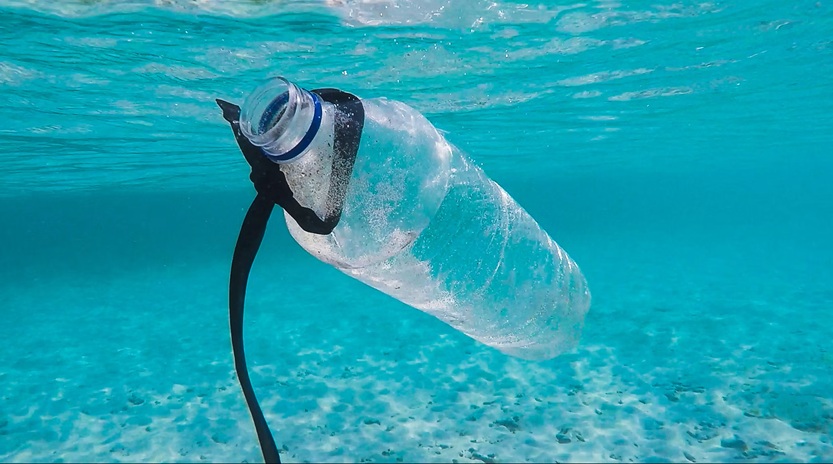
The National Oceanic and Atmospheric Administration (NOAA) explains that some materials remain for a very long time and that glass does not break down at all.
According to NOAA, plastic often does not truly disappear, but breaks down into smaller and smaller pieces. These small particles are difficult to remove and may never fully disappear.
More than just a messy street view
Litter is about more than how a street, park or beach looks. Waste left on the ground can be carried away by wind and rain into ditches, rivers and eventually the sea. NOAA explains that human-made waste is found from coastal areas to very remote places, and that some items may never fully disappear from the environment.
The problem is global
It is important not to see litter as only a local Belgian problem. International organisations show that this is a global issue. UNEP explicitly describes plastic pollution as a global problem. The OECD also expects that, without stronger measures, the amount of plastic entering the environment will continue to rise over the coming decades.
Much of this waste remains for a long time
One of the biggest problems with litter is that many materials remain for a long time. According to NOAA, human-made products can take hundreds of years to break down, and some materials, such as glass, do not break down at all. NOAA also points out that this depends on factors such as the material itself, thickness, sunlight and the place where the waste ends up.
For plastic, this is especially important. Plastic often does not really disappear, but breaks into smaller and smaller pieces, known as microplastics. NOAA explains that these tiny pieces are very difficult to remove and may never completely go away.
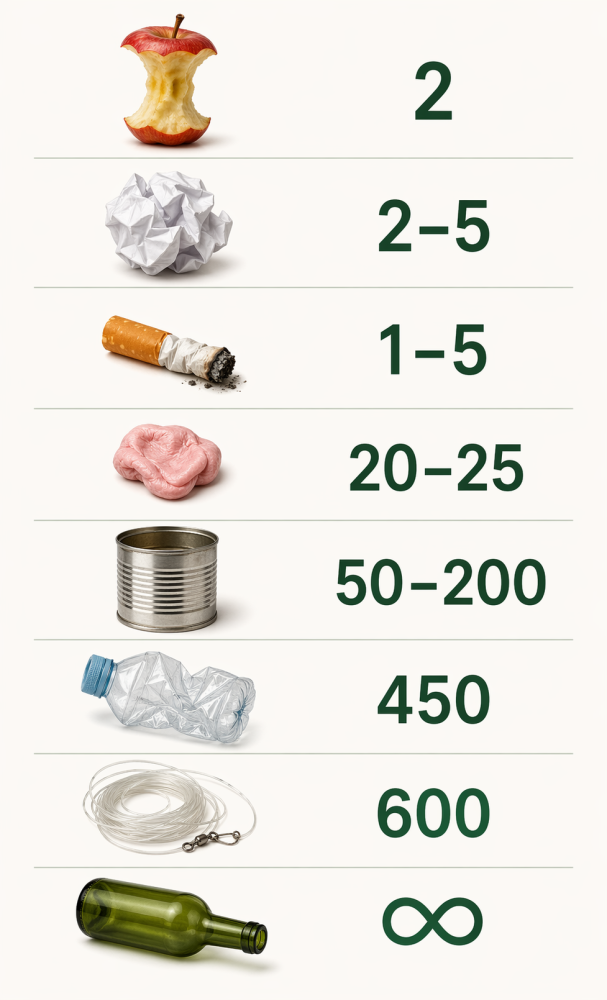
The numbers in this image give an indication of the average number of years different types of waste may need to break down in nature. This process depends on several factors, such as temperature, moisture, sunlight, surroundings and the thickness of the material. In addition, much of this waste does not truly disappear, but breaks down into smaller particles that can end up in the soil and possibly also in groundwater.
Packaging plays a major role
A large share of litter consists of packaging and single-use items. The European Commission states that the ten most commonly found single-use plastic products on European beaches, together with fishing gear, account for 70 percent of all marine litter in the European Union. The Commission also stresses that the consequences of this waste can be serious worldwide.
This shows that the problem is not only about large amounts of waste, but also about many small items that are used and discarded every day.
Why volume also matters
Litter is not only about what ends up next to a bin. It is also about how waste is collected in practice. Empty cans and plastic bottles take up a lot of space. As a result, bins fill up more quickly and need to be emptied more often. This is especially challenging in places where many people gather, such as parks, beaches, squares and leisure locations. The major role of packaging waste fits with the broader international data from organisations such as the European Commission and UNEP.
Cleaning up alone is not enough
Cleaning up more is important, but it does not solve the problem on its own. Litter is also about behaviour. That is why clear waste solutions, visibility and education matter. Involving children in waste collection from an early age can help make correct behaviour easier to recognise and more natural. This also connects to the thinking behind the Playbin: making waste collection not only practical, but also easier to understand and more attractive to use.
Why this background matters for the Playbin
The Playbin was developed from the idea that litter requires more than just a place where waste can be thrown away. International data shows that waste in the environment is a large and lasting problem, that many types of packaging remain for a long time, and that plastic pollution is a worldwide issue. Against that background, it makes sense to look for solutions that make waste collection not only practical, but also more visible and more attractive to use.
Selected sources and further reading
National Oceanic and Atmospheric Administration – The Mystery of How Long Until It’s Gone
European Commission – Single-use plastics
External sources may change or be removed over time.